What Happens When a Domain Expires? The Complete Timeline from Expiry to Deletion
What Happens When a Domain Expires? The Complete Timeline from Expiry to Deletion
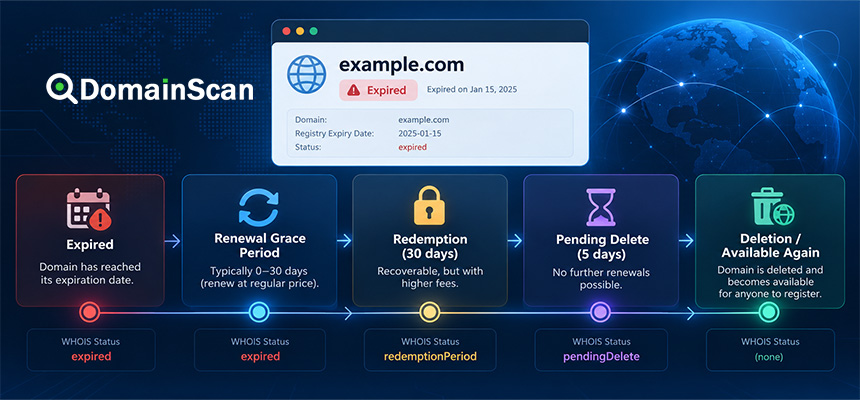
A generic domain (.com, .net, .org and other gTLDs) does not disappear on its expiry date. It usually passes through three stages over roughly 70 to 80 days: a renewal grace period, a 30-day redemption period, and a 5-day pending-delete period. Only after that does it return to the open market.
Which stage a domain is in decides three things: whether the original owner can still get it back, how much that costs, and when someone else can register it. This guide walks through each stage in order, shows the status codes that reveal the stage in a WHOIS or RDAP lookup, and explains where country-code domains (ccTLDs) follow different rules.
The rules below come from ICANN’s Expired Registration Recovery Policy (ERRP), which applies to all ICANN-accredited registrars for gTLDs. Individual registrars can be stricter than the minimums described here, so always check your own registrar’s terms.
Before expiry: the reminders you are owed
Under ICANN policy, your registrar must send at least two renewal reminders before a gTLD domain expires: one about a month before, and one about a week before. If the domain then expires and the registrar deletes it, one more notice must follow within 5 days, with instructions for restoring it.
All of these go to the registrant email in the domain’s registration record. The most common reason people “never got a reminder” is an outdated email address, or a notice filtered into spam. If you manage domains for a business, make sure the registrant email is a shared inbox rather than one person’s address.
Registrars must also publish their renewal fee, any post-expiration renewal fee, and the restore fee on their website. Check these before you need them; the restore fee in particular varies widely between registrars.
Stage 1: expiry day and the renewal grace period (up to 45 days)
On the expiry date, most gTLD registries automatically renew the domain for one year and bill the registrar. This opens the Auto-Renew Grace Period, which can last up to 45 days. During this window the registrar can either collect payment from you or delete the domain and get its money back from the registry.
What this means for you depends entirely on your registrar. ICANN’s minimum is that you must be able to renew for at least 8 days after expiry. Many registrars give the full 30 to 45 days at the normal renewal price; others shorten it.
Somewhere in this period your website and email will stop working. The policy requires the registrar to interrupt DNS for up to 8 days before deleting the domain. Usually the registrar points the domain to a parking page that says it has expired. This outage is intentional: it is the last warning designed to get your attention.
One risk is easy to miss. Some registrars’ terms allow them to auction an expired domain during this period, so a valuable name can be sold to someone else before it ever reaches deletion. If a domain matters to you, do not rely on the grace period at all.
Stage 2: the redemption grace period (30 days)
If the domain is not renewed, the registrar deletes it. For gTLDs, the registry does not release it immediately. Instead it enters a 30-day Redemption Grace Period (RGP), which every gTLD registry is required to offer.
During these 30 days the domain cannot be transferred to anyone else, and only the previous registrant can restore it. DNS stays off for the whole period, so the website and email remain down.
Restoring is possible but expensive. You pay a restore fee on top of the normal renewal price, and registrar restore fees are commonly in the range of several tens of US dollars or more. Contact your registrar directly; restoration is usually not a self-service button.
Stage 3: pending delete and the drop (5 days)
When the 30-day redemption period ends without a restore, the domain moves into pending delete. This lasts 5 days for most gTLDs. At this point nobody can restore it, not even the previous owner, and no registrar can register it yet.
At the end of those 5 days the registry purges the domain and it becomes available to anyone. This moment is called the “drop”. For .com and .net the drop happens in a batch each day, and well-known names are usually caught within seconds by drop-catching services that send registration requests the instant the name is released.
So the realistic answer to “when can I register an expired domain?” is: about 75 days after expiry at the earliest for a typical gTLD, and only if nobody with an automated backorder gets there first.
Timeline at a glance and the status codes to look for
A WHOIS or RDAP lookup shows the stage directly through its status codes. These are standard EPP codes, and registry codes (beginning with “server”) take priority over registrar codes (beginning with “client”). The table lists the typical gTLD sequence; exact days vary by registry and registrar.
| Stage | Typical length | Status codes you will see | Can the owner recover it? | Can others register it? |
|---|---|---|---|---|
| Active | Until expiry date | ok, or client/server Prohibited locks |
Yes, normal renewal | No |
| Renewal grace period | 0–45 days after expiry | autoRenewPeriod, often with clientHold |
Yes, usually at normal price | No, but some registrars may auction it |
| Redemption grace period | 30 days | redemptionPeriod + pendingDelete |
Yes, renewal plus restore fee | No |
| Restore in progress | Up to about 7 days | pendingRestore |
Being restored | No |
| Pending delete | 5 days | pendingDelete alone |
No | No |
| Dropped | — | No record found | Only by registering again | Yes, first come first served |
Two combinations are worth memorising. pendingDelete together with redemptionPeriod means the owner can still restore. pendingDelete on its own means the name is days away from dropping.
A clientHold or serverHold status means the domain is not published in DNS, which is why the website stops loading. It appears during expiry but also for other reasons, such as unpaid invoices or abuse reports.
Country-code domains follow their own rules
ICANN’s expiry policy covers gTLDs only. Country-code domains such as .uk, .de, .my or .cn are run by national registries that set their own lifecycle, and the differences can be large.
.uk is a good example. Under Nominet’s rules, a .uk domain that is not renewed is suspended 30 days after expiry, at which point its website and email stop working. It can still be renewed for a further 60 days while suspended. It is cancelled and released for anyone to register 90 days after the original expiry date, and any renewal up to that point is back-dated to the original expiry date.
There is no separate redemption stage with a restore fee at the registry level, although individual registrars may add their own late-renewal fee. For any other ccTLD, check the registry’s own policy page rather than assuming the gTLD timeline applies.
How to check which stage a domain is in
You can see a domain’s position in this lifecycle in one lookup with the DomainScan WHOIS tool:
- Enter the domain name, without http:// or www, and run the lookup.
- Read the Expiration Date. If it is in the past, the domain is somewhere in the post-expiry stages. If it is about a year in the future but the site is down, the registry may have auto-renewed it and the domain may still be in the grace period.
- Read the Domain Status lines and match them against the table above.
redemptionPeriod,pendingRestoreandpendingDeleteare the codes that matter most. - Note the Registrar. Only the registrar of record can renew or restore the domain, so this tells you who to contact.
- If the lookup returns no record at all, the domain has probably dropped and may be available to register.
Two cautions. Expiry dates in WHOIS for gTLDs can look renewed during the auto-renew grace period even though the owner has not paid. And registry data can lag by a few hours, so for a domain you are waiting to catch, check again close to the expected drop date.
Practical advice
If you own the domain:
- Turn on auto-renew and keep the payment card on the account up to date.
- Use a registrant email that will still be read in five years, ideally a shared address on a different domain from the one being protected.
- For domains that matter, renew for several years at once. It removes the yearly risk entirely.
- If a domain has already expired, act in the first days. Renewal in the grace period usually costs the normal price; waiting until redemption adds a restore fee, and after redemption the name is gone.
If you are waiting for someone else’s domain to expire:
- Use WHOIS to track its status. Nothing happens until
pendingDeleteappears on its own; the drop follows about 5 days later. - The owner can renew at any point before pending delete, so many “expiring” domains are never actually released.
- For a desirable name, a manual registration attempt after the drop rarely succeeds. Backorder services that submit requests automatically are usually faster.